


From Colouring Page to Keepsake Card: Elizabeth Hart’s Scottish Thistle


I love seeing what happens when one of our colouring pages finds its way onto someone else’s craft table. Today I have a lovely project to share from design team member Elizabeth Hart: a Scottish thistle card filled with purple blooms, tartan details and a little sparkle.
Elizabeth shared this card on her blog, Warm Harted — A Scottish Thistle. Do pop over to see her original post and leave her a little love!
The thistles sit inside an illustrated embroidery hoop, surrounded by Celtic knotwork and tartan ribbon. Elizabeth’s soft pink background gives the deeper purple flowers and green leaves room to stand out, while the black mat and plum-coloured card base frame the whole piece.
My favourite finishing touch is the little purple floral sprig tied with a lavender bow. It brings the flowers forward from the page and gives the card that lovely, tactile quality you only get with handmade things.
In her original post, Elizabeth explains that she used watercolour and Copic markers for the colouring, then Distress Oxide inks with a water reaction to create a more vintage look. Flowers, ribbon and glitter complete the card.
It is such a useful idea to tuck away for your own crafting: choose a detail from the printed design and echo it with a real embellishment. A ribbon, a small flower or a touch of sparkle can help a coloured page feel like a finished keepsake.
Elizabeth identifies her image as coming from the Scottish Highlands Coloring Book, Level 2. The thistles, tartan and Celtic details carry the same atmosphere through the wider collection, making it a lovely place to look for coordinating paper-crafting inspiration.
Explore the Scottish Highlands collection in our Etsy shop. Please check each listing’s contents before purchasing so you choose the files you want. The shop offers digital downloads; Elizabeth’s finished card and added embellishments are her own creation.
If this has inspired you to look at your colouring pages a little differently, try pairing a finished image with a contrasting cardstock mat and one small embellishment. You can make it your own without needing to design a card from scratch.
A very warm thank-you to Elizabeth for sharing her beautiful work with us. Visit her Scottish thistle post here for her creative details.
Come create with us. Join the My Grandma’s Teacups newsletter for more printable inspiration, project ideas and news from our collections.
What would you turn a colouring page into—a card, a journal cover or a little framed gift? I would love to hear your ideas.
.png)
There is a particular kind of quiet that arrives before winter: the shop has closed, the household has settled, and one small piece of paper changes what tomorrow might become.
This week we are returning to Genevieve’s haberdashery in Bath and Isla’s ledgers at Ardmuir. Their stories are taking another small step toward the winter expansions coming in November. Afterwards, we will make a simple journal pocket for a letter, a list or a promise worth keeping.
New to these stories? Read Mr. Bowls Collects and Isla’s First Dance before settling in.

Clara’s Christmas Album, Part 1 · A Cottagecore Comforts story and craft-along
Some keepsakes begin with beautiful paper. This one begins with an ordinary brown lunch bag—and the thought of all the little things we would like to keep.
Today we’re building the blank base for a vertical paper bag mini album, following the method shared by Ginger Ropp of My Sisters Scrapper. There is no decorative paper to cut today. After the November release of Clara’s Christmas Expansion, we’ll share our coordinating decorative-paper cutting guide and return to dress these pages together.

There is something lovely about turning a journal page and discovering a little surprise. A pocket holding a letter, a ribbon marking a favourite passage—or, in this case, a blue hydrangea that seems to float inside a clear window.
Today we’re making a double-sided journal tip-in with the rich sapphire blues, warm autumn foliage and graceful ribbon details of the Blue Hydrangea Fall Expansion. A tip-in is simply an extra page attached with a flexible hinge, so it opens to reveal another layer of your journal.
The secret is a clear floral sticker applied to a piece of reclaimed packaging, then tucked between two decorated paper faces. You can leave the window beautifully clear or add transparent sparkle film for a little extra shimmer.

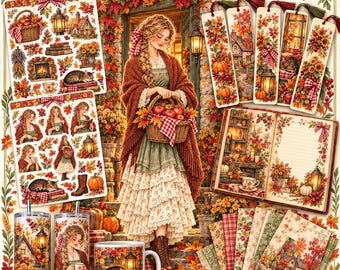
Use the papers and decorative stickers from my Blue Hydrangea Fall Expansion on Etsy, listed as “Blue Hydrangea Junk Journal Kit, Victorian Autumn Ephemera.” The kit includes five design papers, sticker sheets, bookmarks, journal cards and colouring pages. It is a digital download; you will supply the physical craft materials.
For this design, choose the Sapphire Regency Autumn Floral Garland and Ribbon Toss papers, with the hydrangea blossom and coordinating wheat, bow, rose and ivy embellishments from the autumn stickers. This tutorial creates the window and hinge; the finished window page is a project to assemble from your printables.
Reclaimed packaging is often PET rather than acetate. Choose a smooth, flat section and use it only as the supporting window panel. Print onto compatible clear sticker film, then apply that to the packaging.
These measurements make a 5 × 7-inch finished page. Check that this size fits comfortably inside your journal before cutting.
| Piece | Quantity | Size |
|---|---|---|
| Decorated page faces | 2 | 5 × 7 inches each |
| Circular window | 1 in each face | 3¼ inches diameter |
| Clear plastic insert | 1 | 4¼ × 4¼ inches |
| Hydrangea image | 1 | Approximately 2¼ inches wide; preserve proportions |
| Sparkle overlay | Optional | Up to 4¼ × 4¼ inches |
| Hinge strip | 1 | 1 × 7 inches; fold lengthwise |
Print your chosen papers, adhere them to the cardstock, and let them dry flat. Trim both faces to exactly 5 × 7 inches. Use floral garland for the front and ribbon toss for the back. Keep both designs upright. Cut the windows after covering the cardstock so every paper layer has the same opening.
On the first face, mark the window centre 2½ inches from the left edge and 2½ inches down from the top. Draw a circle 3¼ inches across. Its top is ⅞ inch below the page top; its bottom is 4⅛ inches below the top. This leaves space beneath for journaling.
Cut the first circle with a die, circle cutter, or scissors. Use it as a template on the second face: place the two pages with their undecorated inner sides touching, align all four edges, and trace through the hole. Separate, then cut the second opening. Hold them together against the light to check alignment. A die or circle cutter can reduce the need for precise freehand cutting.

Choose a flat panel without ridges, embossing, deep scratches, or cloudy areas. Wash with mild dish soap, rinse, and dry completely. Cut a 4¼-inch square and smooth any rough corners. Do not heat unidentified packaging or feed it through your printer.
Isolate the blue hydrangea blossom from the collection sticker sheet, removing its cream background and white outline. Save it as a PNG with transparency. Make a plain-paper test at about 2¼ inches wide, then print on the coated face of clear inkjet sticker film according to its instructions. Set the printer to actual size. Let the ink dry for the time specified by the film supplier. A transparent PNG will not remain transparent if printed on white sticker paper.
Trim the clear sticker, leaving a small clear margin. Preview its position through the paper window before peeling it. Centre the flower on the plastic, tack one edge down, then peel the backing away gradually while smoothing with a soft cloth. Avoid touching the adhesive or scrubbing the ink. Keep enough empty clear space around the flower to see through the window.
Use TRANSPARENT self-adhesive sparkle film, not opaque holographic vinyl. Once the print is dry, peel back a narrow strip of the liner, align an edge, and smooth the film slowly over the sticker and clear panel. Trim flush with the panel. Test a scrap first: some films make the window hazy or obscure the image. No laminator or iron is needed. The overlay is decorative protection, not a guarantee of waterproofness.

From the back, the flower will appear mirrored and may look paler. Most home inkjet printers do not print a white underlayer, so colours on clear film will be translucent. Test the flower against light and dark backgrounds, and avoid lettering in the transparent focal image.
Lay the front face decorated-side down. Position the clear square on its inner side: its left edge and top edge should each be ⅜ inch from the page edge. The window then has a ½-inch clear-panel overlap around it. Check the flower through the hole and place the back face on top, decorated-side up. Align the page edges and inspect both sides before applying adhesive.
On the inner front face, place narrow double-sided tape around the opening, approximately ⅛ inch outside the cut edge. Keep the tape entirely hidden by the paper and within the clear square. Peel the liners and press the clear panel in place. Use tape suitable for plastic; test its grip on your reclaimed material first.
Fold the 1 × 7-inch hinge strip lengthwise to make two ½-inch wings. Attach one wing to the inner binding edge of the front face, with the fold flush with the page edge and the free wing extending outward. Add thin tape around the window on the inner back face, then paper adhesive or tape on the remaining paper areas and around the page perimeter. Align and close the two faces, capturing the clear panel and hinge wing between them. Press the paper areas gently through clean release paper, leaving the window unscratched. Let the adhesive set flat.
Add the wheat sticker with its pale blue bow on the front and the burgundy rose with ivy on the back. Small petals and cream writing panels can connect the layouts. Keep bulky details away from the window and hinge; reserve clear space to appreciate the floating flower. Use ordinary paper or cardstock embellishments here unless you want additional clear stickers.
Adhere the remaining hinge wing to the chosen journal page, keeping the hinge fold just beyond that page edge so the tip-in can swing open. Avoid placing adhesive over the fold. Support the journal while the adhesive sets, then turn the tip-in gently and check that it closes without catching neighbouring pages. Mount on a sturdy journal page rather than a fragile sheet.
Leave a cream panel beneath the window for a favourite quotation, a little memory or a note about the season. A slender gold paper ring can frame the opening without filling the clear space. Keep embellishments near the hinge fairly flat so the page turns easily.
Save the circles you cut from the page faces. They make lovely gift tags, layered card toppers or small journalling spots—far too pretty for the scrap bin.
Try a lighter page behind the window and follow the sticker-film supplier’s recommended print settings. Adding a white backing makes the flower more opaque, but also blocks the view through that part of the window.
Align the tops and outer edges first. Tiny uneven edges can be covered with a decorative paper ring; a badly misplaced opening needs to be recut on a new face.
Check for fingerprints, protective film, textured packaging or a hazy sparkle overlay. Keep wet glue out of the visible window and test the optional overlay on a scrap first.
Use thinner paper layers and one thin clear panel. Avoid foam tape around the opening and check the movement of the hinge before the adhesive sets.
I love the idea of giving a piece of ordinary clear packaging a second life as something delicate and decorative. Framed by autumn florals, that little floating hydrangea becomes a lovely pause between the written pages of a journal.
If you would like to make your own, you can find the Blue Hydrangea Fall Expansion in my Etsy shop. Choose your papers, put the kettle on, and enjoy making a little window of wonder.
Would you leave your window crystal clear, or add a touch of sparkle? Tell me in the comments—I’d love to hear how you would make this page your own.
Project illustrations were created with AI to explain the design and assembly. Follow the written measurements and test your chosen materials before assembling the page.
These are referral links; I may receive a benefit if you use them. Eligibility and conditions apply.
Explore Starlink through my referral link
Hey, I think you’d like how simple everyday banking can be with Simplii Financial™. Use my link and you can earn when you open and use an eligible account with Simplii™. Conditions apply.
My Simplii Financial referral link
Choose your favourite image and tap “Save to Pinterest” to keep this project for your next creative afternoon.

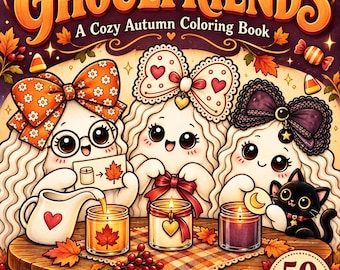
Elizabeth used images from our Best Ghoulfriends colouring book. Download the 50-page printable book and colour your own little autumn gathering.
Get Best Ghoulfriends on EtsyDigital download; no physical item is shipped.
Halloween is creeping closer, and our design team member Elizabeth Hart has given our little ghosts a delightful disguise! She has transformed ghostly colouring pages from Best Ghoulfriends into adorable focal images for her Halloween easel card. With cheerful bows, a cosy campfire and little ghosts standing up to join the fun, Elizabeth has created a scene that is far too sweet to be scary.

Adorable card design, colouring and photograph by Elizabeth Hart of Warm Harted. Ghost images from the Best Ghoulfriends colouring book by Tracy M. Robertson for My Grandma’s Teacups.
The campfire scene makes such a charming centrepiece: three bow-wearing ghoulfriends gather on logs, with pumpkins, a book and a black cat adding to the autumn fun. Elizabeth carries the scene onto the base of her easel card with extra stand-up ghosts, creating a lovely sense of depth.
Her Copic colouring brings the characters to life in warm oranges, fresh greens and golden autumn tones. Glitter adds sparkle to the bows and details, while enamel dots, patterned papers and the glittered Halloween greeting make the finished card feel like a little celebration.
I especially love the bookish ghosts. A cosy read beside a campfire sounds like the perfect way for our Best Ghoulfriends to spend an autumn evening!
Get our free printable book tracker and sign up for new reading-journal layouts from My Grandma’s Teacups.
Get Free Journal LayoutsSign up on our Kit page. Unsubscribe at any time.
All credit for this adorable easel-card design belongs to Elizabeth Hart. Thank you, Elizabeth, for showing us such a creative way to take colouring-book images beyond the page.
See Elizabeth’s original “Best Ghouls..” post on Warm Harted for her project photograph, creative details and craft-challenge links. Do pop over and leave her a little love!
If Elizabeth’s card has you reaching for your colouring supplies, you can find the Best Ghoulfriends printable colouring book in our Etsy shop. It includes 50 easy colouring pages filled with cute ghosts, cosy autumn adventures, pumpkins and bookish moments. Enjoy colouring the scenes, or take inspiration from Elizabeth and use your coloured images in your own personal paper-crafting projects.
Shop the Best Ghoulfriends colouring book on Etsy
This is a digital download for personal use; no physical book is shipped.
Would your ghoulfriends gather around a campfire, curl up with a book or head out for a pumpkin treat? I would love to hear what you would create!
For more design-team projects, printable crafts and cosy creative inspiration, join our My Grandma’s Teacups community.
The featured colouring book, plus more paper-crafting inspiration.
All products shown are digital downloads.
This post contains affiliate links. As an Amazon Associate I earn from qualifying purchases.
Some books draw us into another time and place. Others stay with us because they touch something much deeper. By Mercy Unbroken by Chelsey Welwood did both for me.

By Mercy Unbroken — Tabitha’s Kin, Book 2
Author: Chelsey Welwood
Series: Tabitha’s Kin, Book 2
Genre: Historical Christian romance
Kindle release date: August 28, 2026
Disclosure: I received a complimentary copy of this book from the author. All opinions expressed are entirely my own.
I spent an entire day immersed in this novel. There were moments that gave me chills, others that left my heart aching, and passages that brought me to tears. As the story unfolded, those emotions became part of something hopeful: a moving testament to human love and, above all, to the great love of God.
Welwood’s writing kept me turning the pages, but it was the spiritual depth of the story that stayed with me afterward. I finished the book feeling that I had experienced something far deeper than a beautiful romance.
What touched me most was the way faith shaped the story. God’s love felt central to everything, giving the romance its meaning and emotional depth. As I read, one verse kept returning to me:
“We love because he first loved us.”
— 1 John 4:19
That is the feeling I carried away from By Mercy Unbroken. The love between the characters felt rooted in a greater love, and their journeys invited me to reflect on my own faith. The story reminded me of how profoundly we are loved and of the hope we can find in God’s mercy.
Chelsey Welwood has a gift for writing stories that move the heart while inviting readers to reflect on their relationship with God. This novel comforted me, challenged me to think, and remained with me long after the final page.
I wholeheartedly recommend By Mercy Unbroken to readers who appreciate emotionally powerful historical Christian romance with faith at its heart. Have a few tissues nearby—and leave yourself time to sit with the story when you finish.
I first discovered Chelsey’s writing through Where Stillness Speaks, which I also enjoyed. If you would like to begin with Book 1 or find her newest novel, here are the direct Amazon product links:
Have you read either of Chelsey Welwood’s books? I would love to hear which moments or themes stayed with you. Please keep your comments spoiler-free so other readers can discover the stories for themselves.
For more book reviews and cozy creative inspiration, join the My Grandma’s Teacups community.

There is something so lovely about seeing a creative project come to life in someone else’s hands. Today I wanted to share Becky’s newest YouTube video, where she brings her own beautiful style, ideas, and creative energy to the craft table.
I always enjoy seeing how different makers interpret a collection or project. Sometimes it is the colours they choose, sometimes it is the little finishing touches, and sometimes it is simply the way they explain their process that gives you a fresh idea for your own crafting time.
If you are looking for a little inspiration, a cozy creative break, or just a few minutes to sit with a cup of tea and watch something pretty being made, this is a lovely one to enjoy.
Be sure to visit Becky’s channel, watch the full video, and leave her a little love while you are there. Creative encouragement means so much, especially when someone has taken the time to film, edit, and share their work with the rest of us.
Thank you, Becky, for sharing your creativity with us.